Have Questions? Email support@soracilabs.com

Tesamorelin and Ipamorelin: Two Receptors, One Axis
A GHRH analogue and a ghrelin-receptor agonist reach the same cell by two separate routes. That is the point of pairing them.

In short
A tesamorelin ipamorelin pairing is not two versions of the same idea. Tesamorelin is a GHRH analogue and ipamorelin is a ghrelin-receptor agonist, so they arrive at the same cell through two entirely separate receptors. That is the whole rationale for studying them together rather than separately.
Why a tesamorelin ipamorelin pairing exists at all
Somatotroph cells in the anterior pituitary carry two distinct receptors that both influence growth hormone release. One responds to growth-hormone-releasing hormone. The other responds to ghrelin.
Because those receptors sit on different signalling pathways, a compound acting at one does not occupy or desensitise the other. Consequently the pairing is a genuine two-input design rather than a doubled dose of a single input.
Tesamorelin: a stabilised GHRH analogue
Tesamorelin is a synthetic analogue of human growth-hormone-releasing hormone, modified at the N-terminus to resist the enzymatic clipping that limits native GHRH.
It binds the GHRH receptor, a class B G-protein-coupled receptor, and signals largely through adenylate cyclase and cyclic AMP. Native GHRH is degraded rapidly in plasma, so the modification is the entire point of the molecule.
Notably, tesamorelin carries the most substantial clinical literature of any compound in this category, which makes it a useful reference point in comparative work even when it is not the compound under study.
Ipamorelin: a selective ghrelin-receptor agonist
Ipamorelin is a pentapeptide that acts at GHS-R1a, the growth hormone secretagogue receptor, which is the same receptor ghrelin itself uses. That receptor signals through phospholipase C and intracellular calcium rather than cyclic AMP.
What made ipamorelin interesting in the original literature was its selectivity. Earlier secretagogues in the same family showed appreciable effects on cortisol and prolactin, whereas ipamorelin was characterised as considerably more selective in published comparisons.
In addition, ghrelin-receptor agonists reduce somatostatin tone. Somatostatin is the brake on this system, so easing the brake is mechanistically different from pressing the accelerator.
What the tesamorelin ipamorelin combination is actually testing
Two receptors, two second-messenger systems, and one of them also lifting an inhibitory input. That combination is why the pairing appears in research designs rather than either compound alone.
However, complementary mechanisms do not automatically mean additive outcomes. Whether two pathways sum, saturate or interfere is an empirical question, and it is precisely the question such a study is built to answer.
Handling notes
Both are lyophilised peptides and both are handled the same way: reconstitute with bacteriostatic water, keep the stock cold and protected from light, and avoid repeated freeze-thaw cycles.
Because a blend vial contains two peptides at different masses, the arithmetic is worth doing carefully. Our peptide concentration calculation guide covers the method, and the storage and stability guide covers what degrades first.
Tesamorelin ipamorelin: frequently asked questions
Are tesamorelin and ipamorelin the same class of compound?
No. Tesamorelin is a GHRH analogue acting at the GHRH receptor. Ipamorelin is a growth hormone secretagogue acting at GHS-R1a, the ghrelin receptor. They are different molecules at different receptors, which is why they are studied together.
Why is the blend ratio uneven?
Because the two compounds are not equipotent by mass and do not act at the same receptor. A blend ratio reflects the amounts each protocol calls for, not an attempt to balance them one to one. The exact masses in any given vial are on the product page.
What does selectivity mean for ipamorelin specifically?
In the published characterisation work, ipamorelin produced markedly less effect on cortisol and prolactin than earlier secretagogues in the same family. Selectivity in this context means acting on the intended receptor with fewer off-target endocrine effects, not that it has none.
Does one compound interfere with the other?
They occupy different receptors, so direct competition is not the mechanism to worry about. What can happen downstream is saturation: two inputs converging on the same output can produce less than the sum of their parts. That is a question for the experiment rather than the label.
How should a blend be reconstituted?
The same way as any lyophilised peptide, with bacteriostatic water added gently down the vial wall. The difference is that the concentration calculation has to account for two peptides at two different masses in one volume.
Growth hormone does much of its work indirectly, through insulin-like growth factor 1. For what happens downstream of this axis, see our guide to IGF-1 and its binding proteins.
Related products
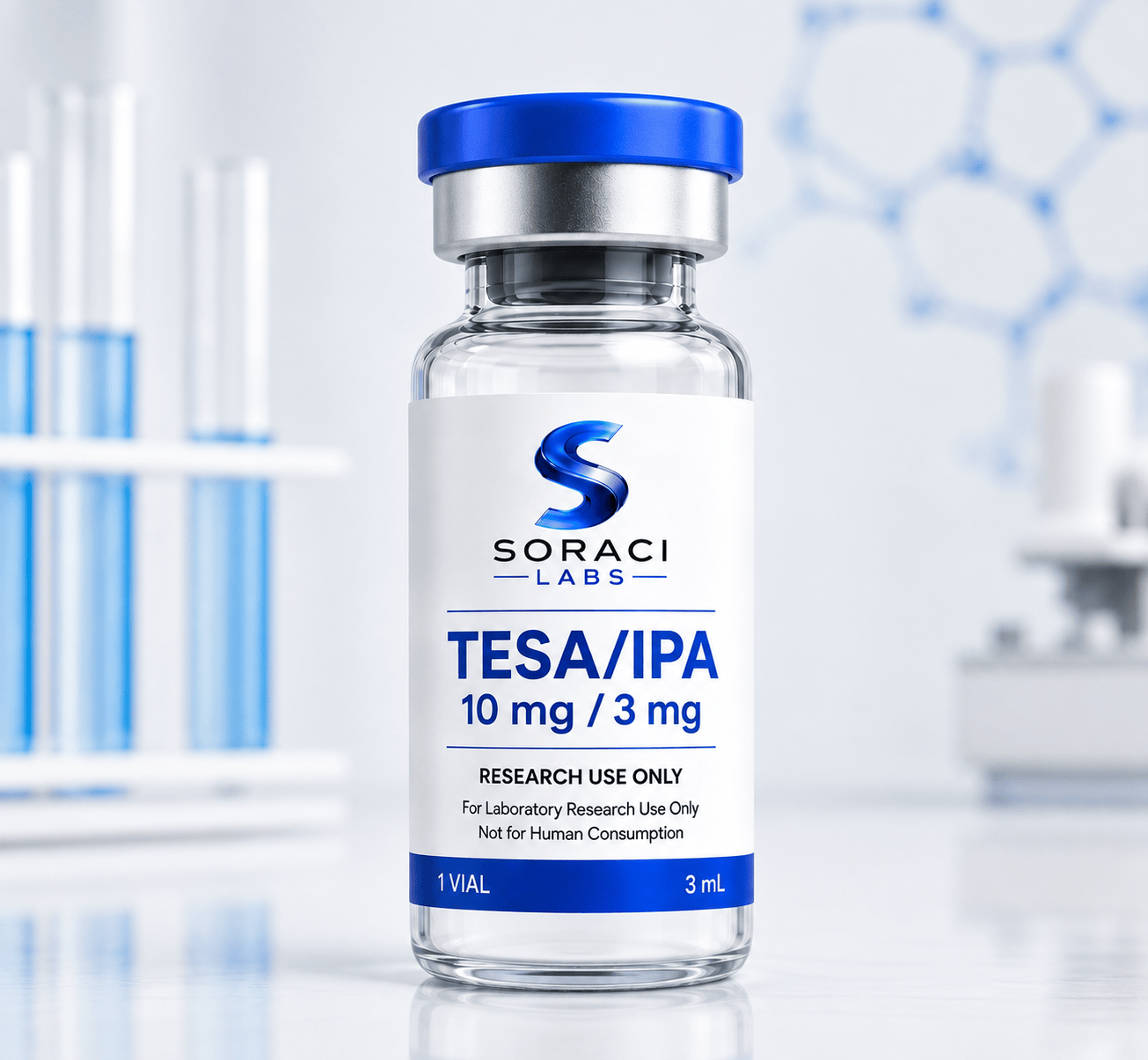
Tesa/Ipa 10mg/3mg supplies both in one vial. The components are also sold separately as Tesamorelin 10mg. Reconstitute with Hospira Bacteriostatic Water 30ml.
References
The sources below are indexed on PubMed, and compound records are held at PubChem.
- Raun K, Hansen BS, Johansen NL, et al. Ipamorelin, the first selective growth hormone secretagogue. European Journal of Endocrinology — the original selectivity characterisation.
- Falutz J, Allas S, Blot K, et al. Metabolic effects of a growth hormone-releasing factor in patients with HIV. New England Journal of Medicine — the principal tesamorelin clinical literature.
- Kojima M, Hosoda H, Date Y, Nakazato M, Matsuo H, Kangawa K. Ghrelin is a growth-hormone-releasing acylated peptide from stomach. Nature — the discovery of the endogenous GHS-R1a ligand.
Research use only. Every product referenced here is sold strictly for in-vitro laboratory research. Nothing on this page is medical advice, and none of these compounds are approved for human or veterinary use, diagnosis or treatment.
[…] is not the only endocrine system these compounds are grouped with. For the growth-hormone side, see tesamorelin and ipamorelin, which reach one cell through two separate […]